
Engagement Rings
Engagement Ring Prong Styles Explained: Claw, Double, Tab and V-Prongs

The prongs on an engagement ring are tiny, but they do two big jobs at once: they hold your center stone securely, and they shape how that stone looks on your hand. Two rings with the same moissanite or lab grown diamond can look surprisingly different simply because one uses four slim claws and the other uses six rounded prongs. This guide walks through the most popular prong styles, how each one affects sparkle, security and everyday comfort, and how to choose the right style for your stone shape and lifestyle.
What Do Prongs Actually Do?
Prongs are the small metal arms that rise from the head of the ring and fold over the edge (the girdle) of the center stone. Because they touch the stone at only a few points, they let in far more light than a full metal rim, which is why prong settings are the classic choice for maximum brilliance.
The trade-off is that each prong is a small contact point that takes daily knocks. The number, shape and thickness of the prongs decide how well your stone is protected, how much metal you see from above, and whether the ring catches on sweaters or hair.


4 Prongs vs 6 Prongs
Four-Prong Settings
Four prongs show the most stone and the least metal. On a round or cushion cut, they create a slightly square outline from above, and on a princess cut they protect the four vulnerable corners perfectly. Four-prong rings feel clean, modern and minimal, and they make the center stone look a touch larger.
The downside: if one prong is damaged, the stone is held by only three. Regular checks matter more with this style, especially on larger stones.
Six-Prong Settings
Six prongs give a softer, rounder outline and add security, because the stone stays supported even if one prong bends. This is the traditional "Tiffany-style" look for round brilliants. Six prongs show slightly more metal, but on a well-crafted setting with slim prongs, the difference in sparkle is very small.
If you work with your hands, garden or go to the gym often, six prongs are a sensible choice. You can browse classic four- and six-prong designs in our moissanite solitaire engagement rings and lab grown diamond solitaire rings.
Prong Tip Shapes Explained
Beyond the number of prongs, the shape of each tip changes the whole personality of a ring.
Round (Ball) Prongs
The most common style. Rounded tips are smooth, comfortable and easy for a jeweler to re-tip as they wear down over the years. They suit almost every stone shape and look timeless.
Claw Prongs
Claw prongs taper to a fine, pointed tip that curves over the stone. They show more of the gem and feel delicate and elegant, which is why they are popular on oval and round solitaires. Because the tips are thinner, they may need checking a little more often.
Tab (Flat) Prongs
Tab prongs are flat and slightly wider, giving a crisp, architectural look. They pair beautifully with emerald, Asscher and radiant cuts, where clean lines match the step-cut facets.
V-Prongs (Chevron Prongs)
V-prongs wrap around a pointed tip like a protective cap. They are essential for pear, marquise, heart and princess shapes, whose sharp points are the most likely place for a chip. If you love a pointed shape, ask for V-prongs at the tips.
Double Prongs
Double prongs place two slim prongs side by side at each holding point, often eight in total. They add security and a decorative, vintage-inspired detail without making the stone look heavily caged.
Compass (East-West) Prongs
Compass prongs sit at north, south, east and west instead of the corners. On a round or cushion stone this creates a fresh, diamond-shaped outline, and on an oval set horizontally it gives a modern, unexpected look.

Matching Prong Style to Stone Shape
- Round: four or six round or claw prongs; compass prongs for a modern twist.
- Oval: four or six claw prongs to keep the elongated outline graceful. Explore our oval moissanite rings.
- Pear and marquise: V-prong at each point plus round prongs along the sides.
- Princess: four V-prongs at the corners.
- Emerald, radiant and Asscher: four tab or double claw prongs on the cut corners.
- Cushion: four or eight double prongs for a softly vintage feel.
Prong Metal and Thickness
Metal choice affects both durability and appearance. Platinum prongs are dense and tend to bend rather than snap, so they hold stones very securely. 14K and 18K white gold prongs look nearly identical to platinum and are a popular, more affordable option, while yellow and rose gold prongs can warm up the look of a stone.
Some couples choose white metal prongs on a yellow gold band so the stone looks icy-white while the band stays warm. Whatever you pick, prongs should be thick enough to protect the stone but not so bulky that they crowd it. A skilled setter balances both.


How to Care for Your Prongs
- Run a fingertip gently over the stone every few weeks. If it feels like a prong catches, or the stone moves or clicks, take it to a jeweler.
- Have the prongs inspected once or twice a year. Re-tipping worn prongs is quick and far cheaper than replacing a lost stone.
- Take your ring off for the gym, heavy lifting, gardening and cleaning with harsh chemicals.
- Avoid pulling sweaters or hair across the ring, which can slowly lift a prong.
- Clean under the prongs with warm water, mild soap and a soft brush so lotion build-up does not dull the sparkle.
Which Prong Style Is Right for You?
If you want the most stone and a clean modern feel, choose four slim claw prongs. If you value security and a classic round outline, go for six prongs. If your stone has a sharp point, V-prongs are non-negotiable. And if you love vintage character, double prongs add charm without hiding your gem. Start by browsing all lab grown diamond engagement rings and compare how different prong styles look on the same shape.
Frequently Asked Questions
Are 4 prongs secure enough for an engagement ring?
Yes. A well-made four-prong setting is secure for everyday wear. Just check it regularly, because if one prong fails the stone relies on three.
Do six prongs make a stone look smaller?
Very slightly at most. Slim, well-shaped prongs hide very little of the stone, and the rounder outline can make a round brilliant look fuller.
Which prong style catches least on clothing?
Round prongs and low-profile settings catch least. Claw prongs and tall cathedral heads are more likely to snag on knits.
How often should prongs be re-tipped?
It depends on wear, but many rings need re-tipping every few years. An annual inspection will tell you when it is time.
Can I change the prongs on my existing ring?
Often, yes. A jeweler can add prongs, convert to V-prongs on pointed stones or rebuild worn tips, depending on the setting design.
Shop the Look
-
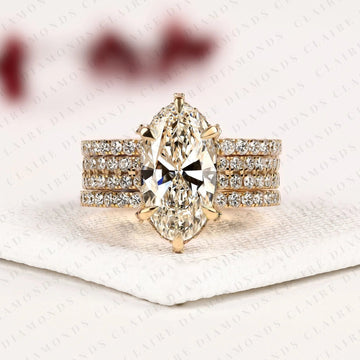 Oval Cut Lab Grown Diamond Hidden Halo Ring Multi Row Pave Gold Band Luxury Bridal Set Wedding Ring for Women
From $ 2,825.00
Shop Now
-
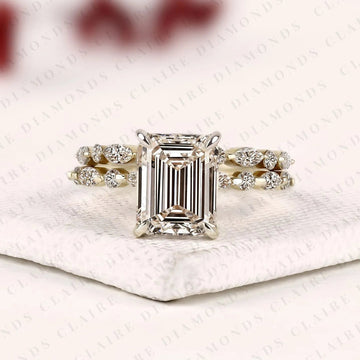 Emerald Cut Lab Grown Diamond Engagement Ring Bridal Set Ring with Pavé Diamond Band Modern Unique Bridal Jewelry
From $ 1,588.00
Shop Now
-
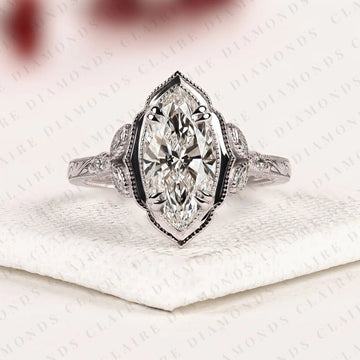 Marquise Cut Lab Grown Diamond Engagement Ring | Vintage Inspired Milgrain Bezel & Engraved White Gold Ring | Floral Diamond Accent Bridal Ring
From $ 1,407.00
Shop Now
-
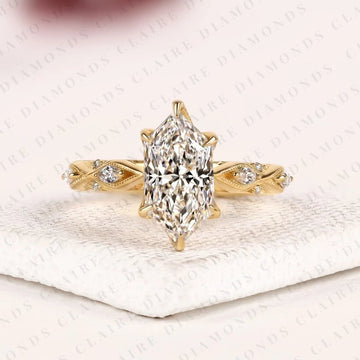 Dutch Marquise Cut Lab Grown Diamond Engagement Ring Leaf Vine Band Nature Inspired Unique Bridal Ring Luxury Wedding Jewelry
From $ 933.00
Shop Now
-
 Marquise Cut Lab Grown Diamond Engagement Ring | Floral Inspired Diamond Side Stone Ring | Yellow Gold Bridal Ring | Elegant Nature Inspired Wedding Jewelry
From $ 1,633.00
Shop Now
-
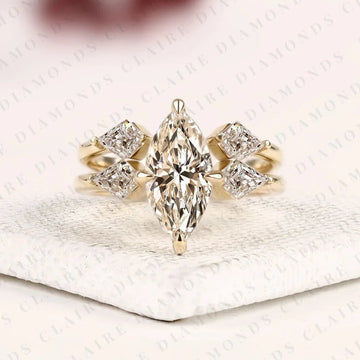 Marquise Cut Lab Grown Diamond Engagement Ring Bridal Set with Kite Cut Three Stone Ring Modern Unique Bridal Jewelry
From $ 1,588.00
Shop Now
-
 Oval Cut Lab Grown Diamond Engagement Ring | Floral Cluster Side Stone Ring | Yellow Gold Nature Inspired Bridal Jewelry | Elegant Statement Wedding Ring
From $ 1,492.00
Shop Now
-
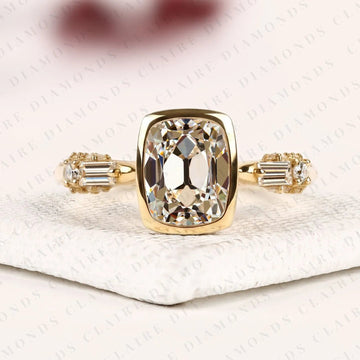 Old Mine Elongated Cushion Cut Lab Grown Diamond Engagement Ring Yellow Gold Bezel Ring with Baguette Side Stone Modern Luxury Bridal Jewelry
From $ 1,554.00
Shop Now
-
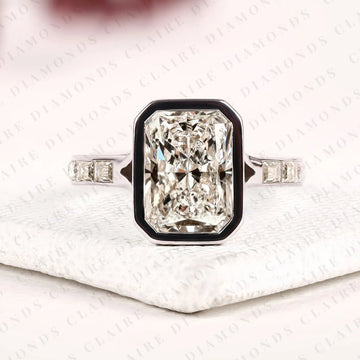 Radiant Cut Lab Grown Diamond Bezel Set Engagement Ring with Baguette Pave Set White Gold Modern Luxury Bridal Jewelry
From $ 1,505.00
Shop Now
-
 Radiant Cut Lab Grown Diamond Three Stone Engagement Ring | Pear Cut Side Stone Gold Ring | Beaded Bezel Statement Bridal Jewelry | Modern Luxury Wedding Ring
From $ 1,468.00
Shop Now
-
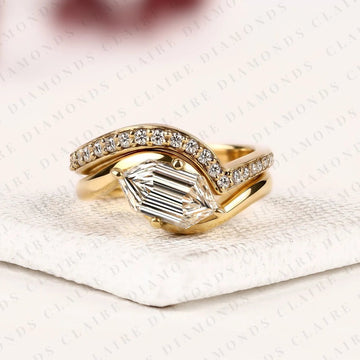 East-West Hexagon Cut Lab Grown Diamond Engagement Ring | Yellow Gold Bypass Pavé Band | Geometric Modern Bridal Ring Set | Unique Statement Jewelry
From $ 873.00
Shop Now
-
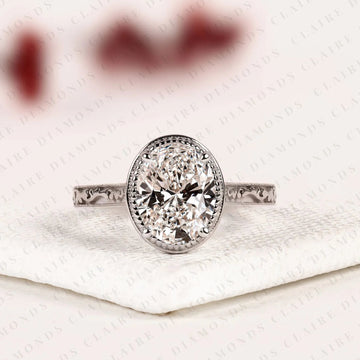 Oval Cut Lab Grown Diamond Engagement Ring Vintage Milgrain Bezel Setting White Gold Engraved Band Elegant Solitaire Bridal Jewelry
From $ 744.00
Shop Now
-
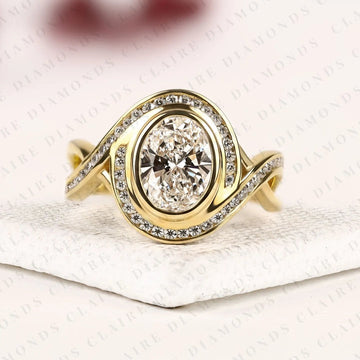 Oval Cut Lab Grown Diamond Engagement Ring | Pavé Bezel Halo Yellow Gold Bypass Ring | Twisted Split Shank Bridal Jewelry | Modern Statement Ring
From $ 939.00
Shop Now
-
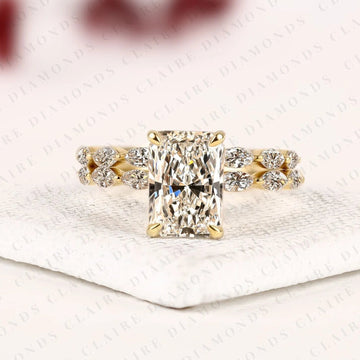 Radiant Cut Lab Grown Diamond Engagement Ring Set Yellow Gold Double Band with Pavé Side Stones Unique Luxury Bridal Ring Set
From $ 1,766.00
Shop Now
-
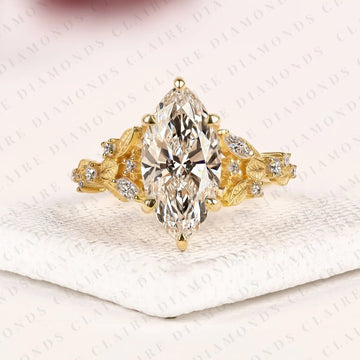 Marquise Cut Lab Grown Diamond Engagement Ring, Floral Leaf Vine Gold Ring, Nature Inspired Bridal Ring, Unique Vintage Wedding Jewelry
From $ 1,407.00
Shop Now


