
Wedding Bands
Lab Grown Diamond vs Moissanite Wedding Bands: Which Should You Choose?
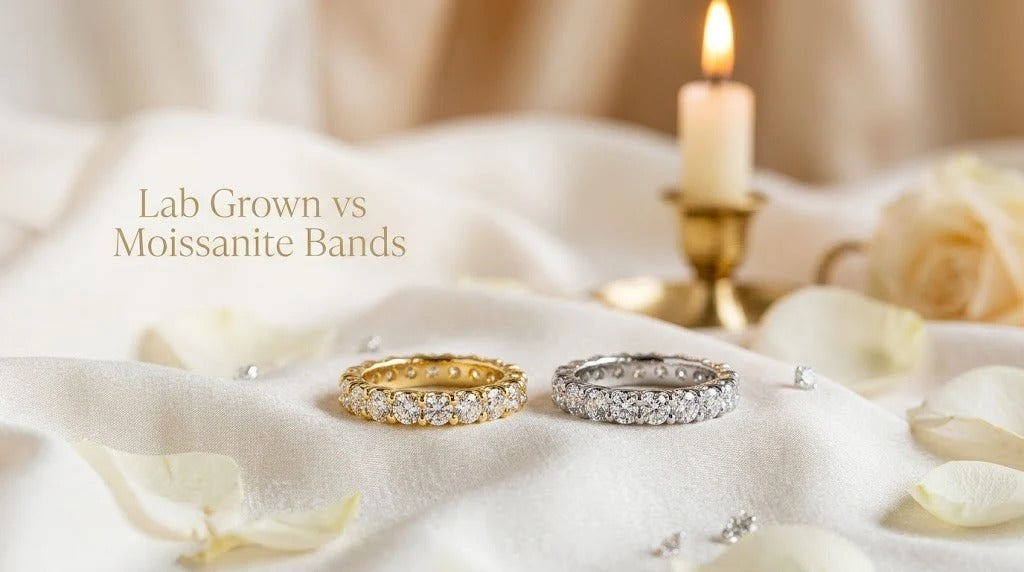
You have found the engagement ring. Now comes a quieter but just as important decision: the wedding band you will wear every single day. For couples choosing modern, conflict-free stones, the question usually narrows to two options — a lab grown diamond wedding band or a moissanite wedding band. Both look beautiful, both are durable, and both cost far less than a mined diamond band. But they are not the same, and the right choice depends on how you live, what your engagement ring is made of, and the look you love.
This guide compares lab grown diamond and moissanite wedding bands side by side — sparkle, durability, colour, matching, price and care — so you can choose with confidence.
The Quick Answer
Choose a lab grown diamond band if you want the classic white, bright look of a diamond and plan to pair it with a lab grown or natural diamond engagement ring. Choose a moissanite band if you love extra fire and rainbow flashes, want the most sparkle for your budget, or are matching a moissanite engagement ring. Either one will hold up beautifully to daily wear.
What Is the Difference Between the Two Stones?
Lab grown diamonds
A lab grown diamond is a real diamond. It is pure crystallised carbon with the same chemical, physical and optical properties as a mined diamond — it is simply grown in a controlled environment instead of underground. It scores 10 on the Mohs hardness scale and is graded for cut, colour, clarity and carat just like any diamond.
Moissanite
Moissanite is silicon carbide, a separate gemstone that was first discovered in a meteor crater and is now created in labs. It scores 9.25 on the Mohs scale, making it harder than sapphire and ruby and one of the most durable gemstones available for jewellery. It has a higher refractive index and dispersion than diamond, which is why it throws more coloured fire.
Sparkle: White Brilliance vs Rainbow Fire
This is the difference most people notice first. Lab grown diamonds return a crisp balance of white light (brilliance) and coloured flashes (fire). Moissanite produces noticeably more fire — bright rainbow sparks, especially in sunlight or under spotlights.
On a wedding band, where stones are usually small (often 1.5mm to 3mm each), the difference is more subtle than on a large centre stone. Many people cannot tell the two apart across a table. Up close and in direct light, moissanite looks a little more "disco-ball", while a lab diamond looks a little more icy and classic.
- Prefer a soft, elegant glow? Lab grown diamond.
- Love maximum sparkle and colour play? Moissanite.
Durability for Everyday Wear
Your band will meet door handles, gym equipment, steering wheels and kitchen counters. Both stones are excellent choices here:
- Lab grown diamond (10 Mohs): the hardest natural material; resistant to scratches from virtually everything.
- Moissanite (9.25 Mohs): extremely scratch-resistant and tough; it will not cloud, fade or lose its sparkle over time.
In practice, the metal and setting style matter more for a band's lifespan than the gap between 9.25 and 10. A full eternity band with shared prongs needs a bit more care than a half eternity or channel-set design, whichever stone you choose.
Colour and Matching Your Engagement Ring
Matching is where the decision often becomes easy.
If your engagement ring is a lab grown diamond
Choose a lab grown diamond band. The stones will share the same colour tone and light behaviour, so the set looks seamless. A moissanite band next to a diamond can show slightly more rainbow fire, which some people love and others find distracting.
If your engagement ring is moissanite
Choose a moissanite band. Modern colourless moissanite (D–F colour range) matches beautifully, and the shared fire keeps the stack consistent.
If you are buying a set together
A coordinated bridal set takes the guesswork out of matching stone, metal and profile. Browse our lab grown diamond bridal ring sets for ready-matched pairs.

Price: How Far Does Your Budget Go?
Both options are dramatically more affordable than mined diamonds, but moissanite is usually the lower-cost choice. That difference lets you go bigger on style — a full eternity instead of a half eternity, larger stones, or a solid gold metal upgrade — without raising your budget.
Lab grown diamond bands cost more than moissanite but still offer significant savings over natural diamonds, and they come with the reassurance of being a real diamond, often with an IGI report for larger stones.
Popular Band Styles for Both Stones
Eternity bands
Stones set all the way (full) or partway (half) around the band. Full eternity bands give non-stop sparkle; half eternity bands are easier to resize and more comfortable for everyday hand use. Explore moissanite eternity bands or lab grown diamond eternity bands.
Curved and contour bands
Designed to hug an engagement ring with a low setting, halo or unusual centre shape so the two sit flush. A smart choice when a straight band leaves a gap.
Classic pavé and channel bands
Slim rows of small stones that pair with almost any solitaire. Channel settings protect the stones' edges, making them especially practical for active lifestyles.
Metal Choice Matters Too
Whichever stone you pick, match the metal to your engagement ring. White gold and platinum make both stones look their whitest; yellow gold adds a warm, vintage feel; rose gold gives a soft, romantic glow. If you plan to wear the band touching your engagement ring every day, matching metals also helps the pieces wear evenly over time.
Care and Cleaning
Both stones clean the same way. Soak your band in warm water with a drop of mild dish soap for 15–20 minutes, brush gently behind the stones with a soft toothbrush, rinse and pat dry. Remove your ring for heavy lifting, gardening and swimming in chlorinated pools. Have the prongs checked by a jeweller once a year — especially on full eternity bands.
Lab Grown Diamond vs Moissanite Bands at a Glance
- Stone type: Lab diamond = real diamond; moissanite = silicon carbide gemstone.
- Hardness: 10 vs 9.25 — both excellent for daily wear.
- Look: Classic white brilliance vs extra rainbow fire.
- Price: Moissanite is typically the more budget-friendly choice.
- Best match: Pair like with like — diamond with diamond, moissanite with moissanite.
Ready to compare styles? Browse all moissanite wedding bands and all lab grown diamond wedding bands side by side.
Frequently Asked Questions
Can I wear a moissanite band with a lab grown diamond engagement ring?
Yes. Many people do, especially to save on a full eternity band. In bright light the moissanite may show a little more rainbow fire than the diamond, so if you want a perfectly uniform look, match the stones.
Will a moissanite wedding band get cloudy over time?
No. Moissanite does not cloud, change colour or lose sparkle. If it ever looks dull, it simply needs cleaning — lotion and skin oils build up behind the stones.
Is a lab grown diamond band worth the extra cost?
If you want a real diamond that matches a diamond engagement ring exactly, yes. If maximum sparkle per dollar is your priority, moissanite offers outstanding value.
Which is better for a full eternity band?
Both work well. Because full eternity bands use many stones, moissanite keeps the cost lower, while lab grown diamonds give the most classic diamond look. Order your exact size, as full eternity bands are difficult to resize.
Can people tell the difference between the two?
On small band stones, most people cannot tell at a glance. Differences in fire become more visible in direct sunlight and on larger stones.
The Bottom Line
There is no wrong answer between a lab grown diamond and a moissanite wedding band — only the one that fits your ring, your lifestyle and your idea of sparkle. Match your engagement ring's stone and metal, choose a band style that suits your daily routine, and you will have a band that shines just as brightly on your fiftieth anniversary as on your wedding day.
Shop the Look
-
 1.75 TCW Emerald Cut Lab Grown Diamond Eternity Band Lab Created Diamond Stackable Band Luxury Bridal Anniversary Jewelry
From $ 1,169.00
Shop Now
-
 1.12 TCW Marquise & Round Cut Lab Grown Diamond Half Eternity Wedding Band Yellow Gold Alternating Band
From $ 821.00
Shop Now
-
 4.00 TCW Pear & Round Cut Lab Grown Diamond Wedding Floral Cluster Eternity Band Vintage Inspired Bridal Jewelry
From $ 2,441.00
Shop Now
-
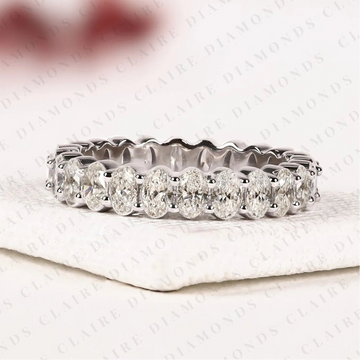 3.90 TCW Oval Cut Lab Grown Diamond Band Eternity Classic Stackable Band Elegant Anniversary Timeless Bridal Jewelry
From $ 2,384.00
Shop Now
-
 3.15 TCW Asscher Cut Lab Grown Diamond Eternity Band, Full Eternity Wedding Ring, White Gold Anniversary Band, Elegant Diamond Ring
From $ 1,950.00
Shop Now
-
 4.80 TCW Marquise Cut Lab Grown Diamond Eternity Band Wedding Elegant Stackable Diamond Band Modern Bridal Jewelry
From $ 2,878.00
Shop Now
-
 3.50 TCW Pear Cut Lab Grown Diamond Band Eternity Wedding Stackable Band Elegant Anniversary & Bridal Jewelry
From $ 2,147.00
Shop Now
-
 2.04 TCW Heart Cut Lab Grown Diamond Eternity Band, Full Eternity Wedding Ring, White Gold Anniversary Band, Unique Bridal Ring
From $ 1,326.00
Shop Now
-
 1.40 TCW Round & Octagon Lab Grown Diamond Band Geometric Wedding Band Modern Stackable Eternity Band
From $ 953.00
Shop Now
-
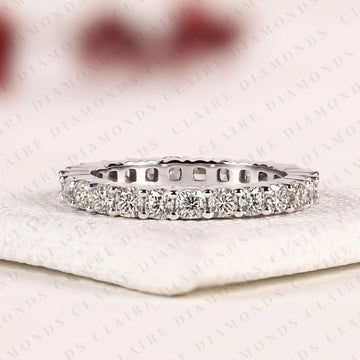 2.50 TCW Round Cut Lab Grown Diamond Eternity Band Full Diamond Wedding Band Classic Stackable Band
From $ 1,572.00
Shop Now
-
 2.00 TCW Baguette Cut Lab Grown Half Eternity Band in Solid Gold | Modern Alternating Baguette Stone Ring, Stackable Anniversary Band for Women
From $ 1,323.00
Shop Now
-
 3.00 TCW Princess Cut Lab Grown Diamond Ring | Alternating Princess Stone Band in Solid Gold, Stackable Anniversary & Everyday Jewelry
From $ 1,859.00
Shop Now
-
 2.00 TCW Baguette & Marquise Lab Grown Diamond Band Vintage Inspired Alternating Stone Anniversary Ring, Elegant Stackable Band & Timeless Everyday Ring
From $ 1,291.00
Shop Now
-
 1.98 TCW Baguette & Octagon Lab Grown Diamond Band Geometric Eternity Wedding Stackable Band Modern Bridal Jewelry
From $ 1,286.00
Shop Now
-
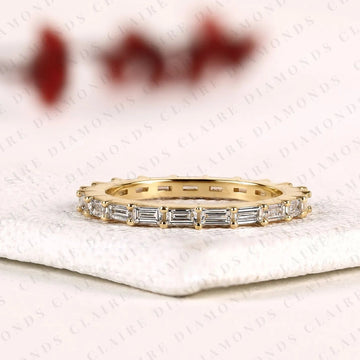 2.64 TCW Baguette Lab Grown Diamond Band Elegant Wedding Band Modern Eternity Band Sustainable Fine Jewelry Gift for Her
From $ 1,657.00
Shop Now


